Search our Site

Franko's Map of The US Virgin Islands

Printed on waterproof, rip-proof plastic. Available folded or flat laminated (like a placemat)

Map size: 26.75" x 18.5"

FM-USVIF (Folded $8.00) ISBN 1-931494-52-5

FM-USVIL (Laminated $16.00) ISBN 1-931494-53-3

Franko’s Guide Map of the United States Virgin Islands

Five years after starting Franko’s Map of the United States Virgin Islands this I finally produced this map in January, 2006!  In the year 2000, I had recently quit my day job as an engineer and went to work on maps of the Caribbean, simultaneously with maps of the Hawaiian Islands.  At the time I fantasized that the U.S. Virgin Islands would be and interesting and beautiful place and so I began to study what is there, particularly in the U.S.V.I underwater, because of my personal interest there.  I learned that St. Thomas was an interesting place, and that Charlotte Amalie is probably the most busy cruise ship port in the Caribbean, that St. John was roughly 2/3 a National Park (Virgin Islands National Park), and that sister Island St. Croix, was seemingly nothing like the other two main islands, but it has world class scuba diving sites.  The more I researched the more I was interested in the U.S. Virgin Islands.  My interest was for their beauty, their beaches, their scuba diving and snorkeling, and for their extraordinary and significant history.  So, was I going to produce a tourism guide map or a dive map, as I had originally thought?  Well, considering that most people who go the St. John, St. Thomas and/or St. Croix go snorkeling or diving as a primary activity, it suits all, I had to produce my usual dive map, but since there is plenty of room on a map for all kinds of other information, I gave the viewer the things to see and do of the U.S. Virgin Islands as well.  Having finally visited the U.S. Virgin Islands I learned what one cannot possibly learn from books and internet studies – that the U.S. Virgin Islands are so lovely and beautiful that words are not really adequate to describe.  My findings and interest in the U.S.V.I. inspired me to make this map into a beautiful piece of artwork.  The mountains are shown in a smooth and wonderful green shaded relief, based on USGS. (United States Geographic Service) digital elevation models (“DEMs”).  The waters around the islands are shown in Caribbean-turquoise blues in descending hues to represent the depths, which are based on data from NOAA (National Oceanic and Atmospheric Administration).  With this U.S. Virgin Islands map background, which I actually first created in the year 2000 I began to load the map with pertinent information about the Virgin Islands, particularly the dozens of superlative dive sites found there.  A year later, the infamous 9/11 happened and I pretty much had to turn off my Caribbean studies and turned my efforts to more localized stuff in my home area of Southern California, plus my home away from home, Hawaii.  In fact, instead of going to the U.S. Virgin Islands at that time, I went to Oahu and created what is known as Franko’s Map of Oahu Surfing, which turns out to be a top seller!  Anyway, things have come full circle, at last, and I have finally released my first edition of Franko’s Map of the U.S. Virgin Islands. 

     When at last I created the maps, I still had an issue about how to present the islands.  That is, do I put St. Thomas and St. John , which are right next to each other on side 1 and put St. Croix, which is far to the south on side 2?  Or do I put St. Croix on side 1, so that it is not the underdog to St. Thomas and St. John.  I also wondered if I should put the Caribbean reef creatures only on one side of the map, or both, plus I debated about having the names of the Caribbean reef creatures in both English and Spanish, since there are so many Puerto Ricans and other Spanish-speaking visitors to the U.S. Virgin Islands, plus about half of the people on St. Croix speak Spanish in the first place.  The answer to my questions came when I realized I could do all of the above at once.  I made St. Croix into side 1 and I made St. Thomas and St. John into side 1.  However, if you are visiting St. Croix, you will see the St. Croix title block of the map showing as side 1, and if you are on St. Thomas or St. John and you see the map for sale, you will see that St. Thomas and St. John are on side 1 and St. Croix is on side 2.  The map is just folded two different ways, but it is still the same durable, water-proof, synthetic paper map, full-color, 2-sided, with the only difference being how it is folded.

As for the fish and other reef creatures, I show them on both sides, but on the St. Croix side of the map, the names are bilingual.  Everybody is happy!  And everybody who visits the U.S. Virgin Islands is happy to have my map, both as a guide and a souvenir.

Make sure to carefully note the colors of my map.  These beautiful colors say,  “The U.S. Virgin Islands are stunning and wonderful!”; and “I love the U.S. Virgin Islands!”  This chain of islands and islets look like emerald jewels spread out across the gorgeous, deepening shades of ocean turquoise.  The map also includes a miniature globe map for a perspective of just where in the world the Virgin Islands are, as they sit far out on the edge of the Continental Shelf where the warm Caribbean meets the vast Atlantic Ocean.  Meanwhile, there is always room for improvement, and inputs are welcome and often very helpful.  So, go ahead and help, if you wish, by emailing to franko@frankosmaps.com


In the following paragraphs I will describe the St. Croix side of Franko’s Map of the United States Virgin Islands, and then I will describe the St. Thomas and St. John side of them map.  IF you are interested in the St. Thomas and St. John description, please scroll down, down, down, because there is a lot to go over on the St. side of the map.


St. Croix side of Franko’s Map of the United States Virgin Islands:    

     It is a well known fact that St. Croix has some of the classiest, most fabulous underwater scenes for scuba diving in the world.  It would be impossible for me to create a guide map of St. Croix that does not have information about the island’s wonderful underwater scene.  St. Croix diving is indeed world-class!  Thus, there are over three dozen dive sites located and accurately described on the Franko’s Map of the United States Virgin Islands, St. Croix side.  It is stated by all of the dive operators in St. Croix that they have the very best diving in the world.  That is why they are there.  It is also stated that only on St. Croix can you dive a wreck, a pier, a reef and a wall on the same day.  It should be noted that this bragging is absolutely true.  In studying St. Croix and developing this map I put the favorite and most known dive sites on the map.  However, St. Croix is a very big island and the dive operators there actually have many more sites than a single map could possibly show.  The dive site names and the descriptions of the favorite dive sites on St. Croix, exactly as they appear on the Franko are as follows in clockwise fashion:


HAMS BLUFF  15' - 75' (5-23m)  Int.

This site is rarely dived due to big swells and location.  Two caves may be

entered only on a calm day.  Sea life

includes green morays, lobsters and

nurse sharks.  Elkhorn coral is prevalent

in the shallows.

VERTIGO  50'-130'+ (14-40m+)  Adv.

The wall begins at about 85' (14m) at the bottom of a steep sandy

slope, and then drops off into the abyss at a spectacular

undercutting angle.  This drop off is dangerous because a diver

can lose track of depth - be careful!  The wall hosts a fantastic

array of black corals, gorgonians, sheet corals, barrel sponges

and tube sponges, as well as all kinds of fishes.

CARAMBOLA/DAVIS BAY  10'-100' (3-30m)  Int.

Snorkel and scuba from shore at Carambola Beach Resort on

a spur and groove reef in shallows.  Deeper divers find

mountainous star corals with undercuts hosting spectacular

elephant ear sponges.  The reeftop is loaded with parrotfish,

damsels, black durgons, tangs and angelfish.  Pelagic species

pass by in the deep.

NORTH STAR  30'-130'+ (9-40m+)  Int. - Adv.

Snorkelers can peer down into the depths as the wall

drop-off begins at only 30' (9m).  Over the wall at 60'

(18m) is a small cave and then a Danish era anchor.  A

seamount rises from the deep to 115' (35m) depth

for an interesting deep dive.  Hawksbill turtles,

blacktip reef sharks and pelagic species are common. 

The reef top is loaded with juvenile fishes.

CANE BAY ("THE WALL")  10' -130'+ (3-40m+)  Beg. - Adv.

Cane Bay is a palm-lined cove at the base of cliffs, with St. Croix's best

wall dive just offshore.  Sometimes currents dictate that the dive site is

accessed via TWIN PALMS, just to the west.  Adding to the interest in

the superb wall are a few old anchors sticking out of a sand chute, with

garden eels peaking out of the sand.  The shallow part of the underwater

here is called CANE BAY GARDEN (25'-50' (8-15m)  Beg.), which is a nice

snorkeling spot, and also a good second dive, because it is rich in brain, star,

elkhorn and gorgonian corals, plus colorful sponge colonies and fishes too

numerous to count.  This area is surfed by locals when the winter kicks up.

PAVILIONS  35' - 130'+ (11-40m+)  Int. - Adv.

Here the north shore wall cuts toward shore, creating

an area with little current or surge.  Sand chutes slope

down with a lining of star, brain and pillar corals in the

shallower areas, then sheet, black, and whip corals

deeper.  Sponges of every form overrun the corals.


PINNACLE (aka: SEAMOUNT or JIMMY'S SURPRISE)

55'-130'+ (17-40m+)  Adv.

This is a deep pinnacle rising from 90' (27m) on it's south

side, with the north side dropping off to the deep.  Currents

often turn this into a drift dive.  Sea fans cover the huge

pinnacle, and the top is a cleaner station where wrasses take

care of big customers.  East of pinnacle are more large coral

mounds.  Caution:  Steep and deep.

RUSTOPTWIST  30'-130'+ (9-40m+)  Int.

This spur and groove reef descends to the St. Croix wall.  Atop the

reef there is a wonderful highlight - seahorses!  These funny fish tend

to like hanging out in the gorgonians and soft corals here.  The edge

of the wall is rich in mountainous star corals and colorful sponges.

GENTLE WINDS  25'-70' (8-21m)  Beg.

This is an excellent spot for experienced snorkelers, or it is a great

second dive.  Gentle Winds is a spur and groove reef with brain, star

and lobed corals of all forms.  Divers see a diversity of fishes and a

few resident hawksbill turtles.  A big coral mound near the mooring is

affectionately called GINGERBREAD HOUSE by local divers.


SALT RIVER CANYON WEST WALL  25'-130'+ (9-40m+)  Int. - Adv.

400 yards west of the East Wall's outer mooring is the West Wall, also within

the Salt River Bay National Historical Park and Ecological Preserve.  Black tree

corals and orange sponges are at 100'+ (30m+).  West Wall dive sites include:

COLUMBUS' BLUFF  30'-100' (9-30m)  Int.

Columbus landed adjacent to this spot during his second voyage to the West

Indies in 1493.  This spot includes a fabulous accumulation of reef deposits at

the edge of the great wall.  Coral pinnacles, orange, green, purple, brown and

a rainbow of colorful sponges and corals create a giant pinnacle maze.

GROUPER GROTTO  25'-130'+ (8-40m+)  Int. - Adv.

Named for the big groupers that rest in the overhangs, and canyons of huge

coral heads and pinnacles.  Eagle rays cruise by the wall, which begins at a

depth of 60' (18m).

SALT RIVER CANYON EAST WALL  30'-130'+ (9-40m+)  Int. - Adv.

Just offshore from where Christopher Columbus landed during his 1493

voyage, this area is within the new Salt River Bay National Historical

Park and Ecological Preserve.  East Wall dive sites include:

RUSS' ROCK, rising from 65' (20m) at the inshore mooring, has a much

undercut coral mound, with sea rod plumes, barrel sponges, and colorful

sponges on top.  Below Russ' Rock are reef patches extending into the deep.

BARRACUDA BANK, at the outer mooring, is noted for numerous curious

barracuda that follow divers around.  Some pelagic species are seen by

divers, including hammerheads.

JASON'S ANCHORS/TWIN ANCHORS  40' - 60' (12-18m)  Int.

Two easily visited big anchors out of over two dozen cargo and

passenger ship anchors that are embedded in this reef.  Mountainous

star coral pinnacles rise up from sandy grooves, where there are

occasional nurse sharks.  Gorgonians are prominent. 

LITTLE COZUMEL  35'-75' (11-22m)  Int.

A mini wall at the mooring gives this canyon its name, because it

is similar to Cozumel's great wall drift dives.  This wall is full of

colorful sponges and loaded with fish.  A box canyon with 25' high

sides is the best part of this dive site.  It offers lots of nooks and

crannies for invertebrates

LOVE SHACK/GREEN SHACK  40' - 65' (12-20m)  Beg.

This spot is named for the beach shack on shore.  A spur and groove reef drops to

the sandy bottom, which goes seaward to a long reef and then a small wall drop off.

WAPA GARDEN  40'-55' (12-17m)  Beg.

Named for Water And Power Authoriy, which is located on shore.  Pinnacles of

mountainous star corals form overhangs for large groupers and nurse sharks.

BLUE CHUTE & CHEZ BARGE  70'-100' (21-30m)  Int.

A 150' long barge has been sitting upside-down since 1978, when it was sunk

for a reef.  Divers feed fish here, and  a resident barracuda named Marlboro

will show his toothy smile, as will Earl, a big green moray who lives under the barge.

LONG REEF  15'-100'+ (5-30m+)  Beg. - Int.

This huge barrier reef stretches for 3 miles outside of Christiansted Harbor.

Good coral gardens found here are a perfect spot for a second dive following a north

shore wall dive.  A seaward-extending complicated spur and groove system boasts

fabulous coral pinnacles.  It was formerly full of elkhorn corals, but Hurricane

Hugo thrashed them in 1989.  The reef is coming back just fine.

EAGLE RAY  30'-100'+ (9-30m)  Beg. - Int.

This sandy slope is made special by its resident white-spotted eagle rays

which pass slowly by.  It also has a number of good-sized southern sting rays.

19TH HOLE  30'-100' (8-30m) Beg. - Int.

This boat dive is short trip from the dock.  It has large coral pinnacles

comprised of giant barrel sponges, brain corals and mountainous star

corals.  Nurse sharks rest beneath overhangs, and numerous and varied

invertebrates shelter amongst coral mounds.

SCOTCH BANK  30'-85' (8-26m)  Beg. - Int.

Named for the dumped cargo of scotch from a grounded ship from the

1700's, this dive site features scattered mounds of corals and sponges. 

Of note are large elephant ear sponges, and also the large variety and

number of tropical Caribbean reef fishes.  The outside wall drops off

steep and deep in typical St. Croix fashion.  It is sometimes a drift dive.

SWIRLING REEF OF DEATH/DAN'S REEF 

30'-40' (9-12m)  Beg.

This rich reef is full of Caribbean fishes and

invertebrates.  Cleaner shrimp may try to take

care of your parasites if you sit still.  Contrary

to the name, it is not notably dangerous.

KING'S REACH REEF  45'-100' (14-30m)  Int.

This is a sandy plain with an anchorage area at 45' (14m)

depth.  Sand is full of garden eels.  The gradual slope is

covered in bright sponges of all types and mountainous,

star, brain, starlet, sheet, wire and lobed corals.

FREDRIKSTED PIER  10'-50' (3-15m)  Beg.

This is a particularly good night dive at the

rebuilt pier.  Look closely for seahorses, spotted

scorpionfish, and big silver tarpon.  Remnants of

the old pier are still encrusted with amazing,

colorful sponges.  Night divers will see lots

of lobsters. 

SPRAT HOLE  25'-55' (8-17m)  Beg.

Dive offshore from U.S. Naval Reserve

at Estate Sprat Hall.  This dive drops

down a heavy warship chain tethered to

a huge orange buoy.  Since this is the

leeward side of the island, it is usually calm.

The sandy bottom is surrounded by lobed

star corals.  Garden eels, goatfish and

southern stingrays live in the sand.

ARMAGEDDON PLAIN 

70'-115' (21-35m)  Int. - Adv.

Dive on jumbled pier pilings which

were dumped here after the

Fredriksted Pier was demolished

by Hurricane Hugo in 1989. 

Boats anchor atop TRUCK LAGOON,

which is a pile of Hess Oil trucks

dumped here for a reef in the 1970's.

BUTLER BAY WRECKS  20'-100'+ (6-30m+)  Int. - Adv.

Boat in from Fredrikstead to a bay full of wrecks.  Divers

may explore the following:

SUFFOLK MAID, a 123' (37.5m) English trawler, which was

smashed in a 1984 storm and sunk in 1985 at 45' (14m) depth.

VIRGIN ISLANDER, a 300' (91m) oil barge sunk for reef in

1991.  Note:  Fire coral likes the boat's flat surfaces.

NORTHWIND (WISERVICE III), a 75' (23m) ocean tug,

which was sunk in 1986 at 50' (15m) depth.

ROSA MARIA, a 177' (54m) Venezuelan freighter, which capsized

and was towed upside-down to 110' depth and sunk in 1986, but it

landed right-side-up on the bottom, and two people died in the

sinking process.  Super-structure is at 70' (21m) depth range.

Large barracuda like this wreck.

COAKLEY BAY, an 83' (25m) oil tug sunk for reef in 1999.  Encrustation

of marine life and corrosion is slowly overtaking this wreck.


In addition to the sites around St. Croix, one cannot overlook the fabulous mini Caribbean island called Buck Island, which carries a distinction of being a United States National Monument.  This status, as any visitor will attest, is deserved because Buck Island is so incredibly pristine both in and out of the water.  The island is surrounded by shallow reefs, and any visitor to St. Croix simply must also visit Buck Island.  The description of Buck Island as found on my St. Croix map is as follows:


Buck Island:  This pristine little Caribbean island is a must visit for anyone who

goes to St. Croix.  This island is an unspoiled natural habitat surrounded more than

70% by a rich coral reef barrier, which is much comprised of elkhorn corals, and all

kinds of tropical Caribbean marine life.  The Buck Island environment, including its

surounding waters, has been protected since 1948 and has been a National Monument

since 1961.  Beaches are nesting grounds for hawksbill, leatherback and green sea

turtles.  The island itself is a nesting ground for Caribbean brown pelicans and other

sea birds.  The reef includes a marine garden "trail" with underwater signs for

snorkelers to follow and learn about the tropical fishes, corals and sponges.  Buck

Island has a hiking trail to the 340' (104m) peak, where the view of the turquoise

waters below, as well as the Island of St. Croix, is absolutely stunning.  Official

concessionaires who take snorkelers, divers and explorers to Buck Island include

Captain Heinz, out of Green Cay Marina, and Dive St. Croix, from Christiansted.

Excursions are half-day or full-day. 


If you begin to read the other captions of things to see and do and information about St. Croix that is all around this map you might just start setting the goal to make your visit to this great Caribbean destination.  The more you study and look at this beautiful map, the closer you are to your trip to St. Croix in the U.S. Virgin Islands.  To help start you on your trip, if you don’t already have your Franko Map of the U.S. Virgin Islands, here are the non-dive site captions found on the map (Check out the Columbus Landing site on St. Croix – Did you know that Columbus actually landed on United States soil?):


St. Croix This fabulous island is unique amongst the Virgin Islands in topography, geology and its very nature.  The eastern end is drier and mostly devoted to agriculture.  The hilly west end is forested and receives over 55 in (140cm) of rain annually on the windward slopes.  The islands of St. Thomas and St. John are volcanic, whereas St. Croix is an upheaved chunk of tectonic plate with granite rock.  The underwater on the north shows evidence of this as it drops off into the deep nearly vertically for thousands of feet.  At one time the island supported many sugar mills and plantations, and some of the colonial houses still survive.  Tourism is St. Croix's main industry, although it is less visited than its sister U. S. Virgin Islands, St. Thomas and St. John, 40 mi (65 km) to the north.  The island is of mixed cultural descent, with many descendents of African

slaves, who are the original "Cruzans,” as well as a large percentage of Spanish-speaking Puerto Ricans.  St. Croix is progressing as a visitor haven, and it is fortunate that it boasts world-class scuba diving and snorkeling, and Buck Island, a fabulous and pristine mini Caribbean island.  Buses operate between Frederiksted and Christiansted.  Guided tour operators take visitors around St. Croix, and there are guided hikes at Butler Bay, Salt River National Historic Park, and other areas.  Unfortunately, Hurricane Hugo smashed into St. Croix in full force in 1989, destroying the majority of homes and buildings on the island.  Fortunately however, many of the historic buildings were so well constructed that they survived.  In 1995, Hurricane Marilyn bashed St. Croix and much of the rebuilding was demolished.  The wonderful green hills of St. Croix belie the fierceness of the hurricanes that have swept across the area over the eons.  St. Croix is known as a scuba diver's paradise, with numerous incredible dive sites.  Dive shops on St. Croix boast that This is the only place in the world where a diver can dive a wall, a pier, a reef and a wreck all in one day.  St. Croix's waters are teaming 100's of species of fish and invertebrates on it's colorful corals, sponges and rocks.


Columbus Landing Site of St. Croix.  It was here at

Salt River Bay that Christopher Columbus landed

during his second voyage in 1493.  This is the site of

the first European confrontation with the Carib

tribe.  This is the only site under the flag of the

U.S.A. where Columbus made landfall.  However,

Columbus still figured he was near India!


Judith's Fancy  Named

for 17th century estate

owner.  250 year-old

Danish great house

was the largest plantation

on St. Croix.


Point Udall  This scenic  point is the easternmost

point in the United States.  The Isaac Bay Trail

here leads to a beach with a coral reef.  This remote

point has a huge National Science Foundation

antenna observatory for exploring the Universe.


Grapetree Beach  This white sandy beach is

remote and usually empty, although Divi Resort

has been repaired since being wiped out by

Hurricane Hugo in 1989.


Great Salt Pond Bay  Here there are salt flats and

ponds in what appears to be an desert by the sea. 

This is a bird watchers delight. 


Cruzan Rum Distillery  This is from where the famous


Cruzan Rum comes.  Tours show the history of St. Croix

sugar cane and the rum-making process.  Tourists may

sample rums in the tasting room.


St. George Botanical Garden  This is a

1700's sugar plantation which has been

renovated and surrounded by a collection

of tropical flora, including medicinal herbs.

There are also scant remnants of the

pre-Columbian Arawaks from well over

1,000 years ago.


The Estate Whim Plantation  This is a restored 1700's

sugar estate, complete with fancy furnishings of the era's

wealthy plantation owners.  The green grounds, including a

beautifully restored windmill, are toured with guides.  The

St. Croix Landmarks Society is located here, and many of

its special events are held on the grounds.  Novelty items

are available at the museum gift shop.


Sandy Point Wildlife Preserve  The Westend

Saltpond is a fantastic bird-watching spot,

especially for flocks of great pink flamingos.

This is one of the best places in the world

to watch the sunset.


Lawaetz Museum  Mid-1700's sugar plantation has

an 1838 house that is now a museum showing

early 1900's St. Croix farm life.

Sprat Hall Plantation  French Great House

from the 1600's has a huge antiques collection,

guest cottages, and equestrian tours.


Caldonia Valley  Tropical sub-rain

forest has teak, kapok, and mahogany

trees in St. Croix's most lush forest.


Carambola Estate

The "carambola" or

"star fruit" grows

throughout this estate.


St. Croix Heritage Trail  Circumnavigate via

rental car to St. Croix's historic sites, ruins,

attractions, beautiful natural areas, and vistas

along 72 miles (117 km) of roadway.  Sites range

from the Easternmost extreme at Point Udall, to

the remotest spot, Hams Bay on the Northwest

corner of St. Croix.  Also visit the island’s most

populous towns of Christiansted, with its National

Historic Park, and Frederiksted, with its beaches

and shops.  On the north end this trail takes you to

the only place in U.S. Territory where Columbus

made landfall, at Salt River Bay, in 1493.  Historic

Sites are marked by Heritage Trail signs all around

the island.  The trail includes coastline, farm country,

tropical forests, and more.  Check out the St. Croix

Landmarks Society's website at

www.stcroixheritagetrail.com for more information.


Of course you can’t have a Franko Map of St. Croix and not have an inset map of Christiansted and another for Fredriksted.  These are the major cities of St. Croix and are the places where most visitors go.  Franko’s Map of the U.S. Virgin Islands details and describes these towns.  Chistiansted is described on the map in a caption as follows:


Christiansted  One of the Caribbean's

most beautifully situated towns has

pastel buildings and arcade-style shops.

The town was founded by the Danes in

1733, and has much remaining 18th-

century architecture.  The waterfront

is a National Historic Site since 1952. 

Arts, crafts, and duty-free shopping are

popular, and accommodations are fine.


Since Chirstiansted is so important historically, and since there are so many wonderful historic places to see, the map must naturally show where they are.  Here are the sites you will find when you make that trip to St. Croix and wander around Chistiansted:


Historic Sites:

Hamilton Jackson Park

Friedenthal Moravian Church (1854)

St. John's Angelican Church (1760)

Holy Cross Catholic Church

Fort Christiansvaern (1749)

Old Danish Customs House (1734)

Scale House/Visitors Bureau (1856)

Danish West India and Guinea Co. Warehouse (1749)

Steeple Building Museum (1753)

Hamilton House (1750)

Government House (1747)

Lord of Sabbath Lutheran Church (1740)

King's Wharf


Since Christiansted, St. Croix is a major destination, its accommodations are also listed:


Accomodations:

Schooner Bay Condos

Danish Manor

Breakfast Club

Hotel on the Cay

Kings Christian Hotel

Kings Alley Hotel

Vacation Villas

Club Comanche

Caravelle Hotel

Dorado Inn

Best Western Holgar Danske

Kronegade Inn

Pink Fancy

Club St. Croix

Sugar Beach Resort


Besides those found in Christiansted, around St. Croix there are various hotels and resorts which are named and located on the map.  They are as follows: 


St. Croix Yacht Club

Cotton Beach Resort

Divi Carina Bay

Resort & Casino

Paradise Sunset Beach

Carambola

Beach Resort

Waves at Cane Bay Resort

Cane Bay Reef Club

Gentle Winds Resort

Villa Margarita

Hibiscus Beach Hotel

Cormorant Beach Club

Inn At Pelican Heights

Colony Cove Beach Resort

Sugar Beach

Club St. Croix

Buccaneer Hotel

Tamarind Reef

Chenay Beach Resort


Meanwhile Fredriksted has a detail with a description as well.  Fredriksted’s history has been marred by devastating tsunami, consuming fire and vicious hurricanes.  These days, it is unfortunately said that Fredriksted’s street crime is also of note and worry, and thus visitors have been staying away in droves.  However, with a cruise ship pier, and with circle-island tours around St. Croix beginning in Christiansted, there are still a large and growing number of day visitors.  The town is described as follows on the Franko Map of St. Croix:


Frederiksted  This is the 2nd largest town

in the USVI.  Established in 1751, but was

destroyed by a tsunami in 1867, and then by

fire in 1878, and again much damaged by

Hurricane Hugo in 1989.  Town now has much

Victorian-style architecture.  Frederiksted

is toured in 1 day. Much of this town appears

old and run down, and it is said that visitors

should be aware of street crime.


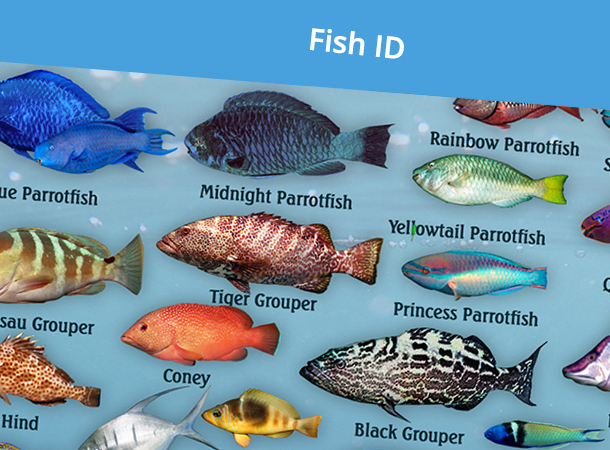
For my own entertainment and delight, the entire bottom of Franko’s Map of St. Croix is highlighted, enlivened and beautified by Franko’s Caribbean Reef Creatures, with over 100 species depicted and named in both English and Spanish.  Adding fish and other reef creatures to my maps was an idea that I had and began to do starting with Franko’s Map of Santa Catalina Island (my beloved Catalina Island, California) in the late 1990’s.  With this Franko Map depicting the U.S. Virgin Islands, I think I’ve done my best yet in this regard.  This is partly because I enlisted the help of my bilingual daughter (she teaches high school Spanish to native Hispanics) to edit my names on:

“VIRGIN ISLANDS REEF CREATURES”, or

“Criaturas Del Arrecife De Islas Virgenes”

The species include the usual cast of characters.  In case you need to translate 100 or so species into English (or into Spanish) the list is as follows, alphabetically with the English name first:


Banded Butterflyfish Mariposa Bandeada

Bar Jack Cojinuda Carbonera

Barred Hamlet Vaca Manchada

Basket Sponge Esponja Cesta

Bermuda Chub Chopa Blanca

Bi-color Damselfish Jaqueta Coliblanca

Black Durgon Calafate Negro

Black Grouper Abadejo

Black Sea Cucumber Pepino Negro del Mar

Blacktip Reef Shark Tiburon de Aletas Negras

Blue Angelfish Pez Ángel Azul

Blue Parrotfish Loro Azul

Blue Chromis Castañeta Azul

Blue Tang Cirujano Azul

Bluehead Wrasse Diamasel

Bluestriped Grunt Chachi Amarillo

Branching Vase Sponge La Esponja del Jarrón

Brown Chromis Castañeta Marrón

Brown Tube Sponge Esponja Marrón

Caesar Grunt Ronco Caesar

Cero Carite Chinigua

Cleaning Goby Limpiador Gobio

Clown Wrasse Doncella Payaso

Coney Cherna Cabrilla

Coral Crab Congrejo de Coral

Creole Wrasse Doncella Criolla

Cushion Sea Star Estrella de Mar

Dolphin Fish (Mahi Mahi) Dorado

Elkhorn Coral Coral Orejón

Fairy Basslet Gramma Real

Finger Coral Coral Digitadol

Fire Coral Coral de Fuego

Foureye  Butterflyfish Mariposa de Cuatro Ojos

French Angelfish Pez Ángel Frances

French Grunt Ronco Amarillo

Graysby Cabrilla

Green Razorfish Doncella Verde

Grey Snapper Pargo Prieto

Glasseye Snapper Catalufa de Roca

Giant Brain Coral Coral Cerebro Gigante

Gray Angelfish Pez Ángel Gris

Gorgonian Fan Abanico de Gorgonaceo

Great Barracuda Picuda Barracuda

Green Moray Eel Morena Verde

Hermit Crab Congrejo Eremito

Hogfish Boquinete

Honeycomb Cowfish Torito de Panal

Horse-eye Jack Jurel Ojón

Jawfish Bocón

Laminado Sand Diver Pez Lagarto

Longspine Squirrelfish Candil Soldado

Long-spined Sea Urchin Erizo Negro de Mar

Mahogany Snapper Pargo Ojón

Mountainous Star Coral Coral Montañoso

Nassau Grouper Mero Criollo

Nurse Shark Tiburón Nódriza

Ocean Triggerfish Pejepuerco Del Mar

Octopus Pulpo

Orange Sponge Esponja Anaranjada

Orange-spotted Filefish Lija Pintada

Orange Tube Sponge Esponja Anaranjada

Palometa Palometa

Peacock Flounder Lenguado Pavón

Pink Vase Sponge Esponja Rosada

Pluma Pluma

Princess Parrotfish Loro Princesa

Queen Angelfish Pez Ángel Reina

Queen Conch Concha Reina

Queen Parrotfish Loro Perico

Queen Triggerfish Pejepuerco Cachuo

Rainbow Parrotfish Loro Guacamayo

Red Hind Mero Colorado

Redlip Blenny Blenico Atlántico

Reef Butterflyfish Mariposa de Arrecife

Rock Beauty Isabelita Medioluto

Sand Tilefish Matajuelo

Sargassum Triggerfish Pejepuerco Del Sargassum

Scrawled Filefish Gallo Azul

Schoolmaster Pargo Dientón

Sea Anemone Anémona de Mar

Sea Fan Abannico Común

Sea Horse Caballito de Mar

Sea Rod Barra de Mar

Sergeant Major Petaca Rayada

Sharpnose Puffer Boteto Bonito

Sheet Coral Coral

Smooth Trunkfish Chapin Baqueta

Southern Stingray Raya Látigo Americana

Spanish Hogfish Peja Perro

Spiny Lobster Langosta Caribeña

Spotfin Butterflyfish Mariposa Amarilla

Spotted Drum Obispo Manchado

Spotted Moray Eel Morena Pintada

Spotted Scorpionfish Rascacio Negro

Spotted Trunkfish Chapin Pintado

Squirrelfish Pez Ardilla

Staghorn Coral Coral Candelabro

Stoplight Parrotfish Loro Viejo

Striped Burrfish Pez Erizo Rayado

Tarpon Sábalo

Tiger Grouper Cuna Gata

Tobacco Fish Jácome

Tomtate Ronco Jeniguano

Triton's Trumpet Tompeta de Triton

Trumpetfish Trompeta

White Grunt Ronco Margariteño

White-spotted Filefish Lija Manchada

White-spotted Eagle Ray Chucho Pintado

Yellowfin Damselfish Jaqueta Colirrubia

Yellowhead Wrasse Platanito

Yellowtail Parrotfish Loro Colirrubio

Yellow Tube Sponge Esponja Pintada

Yellow Stingray Raya Pintada

Yellowstriped Goatfish Salmonete Amarillo

Yellowtail Snapper Rubia-Cana


In case you want to take the map with you snorkeling so that you can speak bilingual to the fish, calling them by name in both Spanish and English, this Franko Map is 100% waterproof, and it is very durable as well, since it is printed on synthetic paper.  However, if you want to have a genuine Franko Fish card that will suffice for that purpose, you should check out Franko’s Virgin Islands Reef Creature Guide. 


St. Thomas and St. John side of Franko’s Map of the United States Virgin Islands:   

Reading the St. Croix side of the map is just a warm-up, because the details on this side of the map are for two islands that are amongst the busiest, most visited places in the whole Caribbean Sea.  They are combined and individually amongst the most beautiful places in the Caribbean Sea as well.  In fact, both St. Thomas and St. John are world-class destinations by any standard, and by studying Franko’s Map of St. Thomas and ST. John, you will definitely set your sites on a visit there some time soon.  St. John is actually where my study began, because of its fame for the fabulous Virgin Islands National Park.  It seems that everyone has seen a lovely picture of Trunk Bay, even if they did not know it was Trunk Bay on St. John.  I’ve seen it in movies and magazines, and finally I went there, took my own photo from the most popular vantage, and put it on my own map!  I also had the pleasure of snorkeling down there on a summer day when the water was dead-flat calm, and the temperature of the water was 87 degrees.  That was just too warm!  When I was in the U.S. Virgin Islands in August of 2005 I was scuba diving and snorkeling is water that actually felt too warm.  The ocean engineer part of me said to myself that this was an unbelievable amount of stored solar energy in the Caribbean at this time.  No wonder there have been so many hurricanes!  Then, the next day, Hurricane Katrina began spinning near the Bahamas, plowed through Florida, and went on to become the monster that annihilated New Orleans, and the Mississippi and Alabama Gulf Coast.  Fortunately, other than warm, humid weather and cloudiness, it did not affect the U.S. Virgin Islands.  Never the less, it was a reminder of how vulnerable this paradise is to hurricanes.  Hurricanes have played a large role in Virgin Islands history, and has shaped the scope of human activity and the placement of towns and harbors on these islands. 


Of course, I have to put my favorite dive sites on the map.  No, I haven’t personally dived every spot in the United States Virgin Islands, but yes, I have gathered information from experts who have.  This side of Franko’s Map of the U.S. Virgin Islands has the locations and descriptions of approximately four dozen dive sites, many of which are famous, such as Trunk Bay’s underwater Trail, and Buck Island (this is not the same Buck Island that is a National Monument near St. Croix) and are world-class, and many of which are much less visited, owing to location or remoteness.  These islands have just about every kind of Caribbean dive there is, and the snorkeling is so easy, interesting and delightful that some scuba divers don’t even bother to scuba dive on their visit, but spend their hours free diving.  The dive sites and descriptions appearing on this Franko Map of the U.S. Virgin Islands, St. Thomas and St. John side are as follows:


CREAKING ROCK  to 65' (20m)  Int.

A huge boulder slightly rocks in surge, making a wierd

creaking sound.  This is often a drift dive.  It is a good

place to see spotted drums and pipefish.

THE ARENA  25'-75' (8-23m)  Adv.

Usually a drift dive, "The Arena" is a natural

sand-filled bowl within a ring of volcanic boulders,

covered with gorgonians and filled with corals, sponges,

sea rods, and sea fans more common to deeper water.

WITSERVICE IV  80'-100' (24-30m)  Int. - Adv.

This 123' tug  sank portside-down after hitting Dry Rocks

while towing a barge in 1979, and wasn't rediscovered until

2001.  Now it is covered with corals and sponges - watch out

for black hydroids and fire coral.  Hawksbill turtles rest here.

A huge grouper occupies the stern.

WITSHOAL II  30' - 90' (9-27m)  Int. - Adv.

This is a 328' WWII tank-landing craft, which was converted

to a freighter, and finally sunk in 1985 at 90' for a reef

BLACKBEARD'S EYE  to 30' (24m)  Int.

A shallow tunnel goes to sunlit pool within Saba Island.  After a

short exploration in the cave, this dive leads south to "The Fence".

THE FENCE  30'-80' (9-24m)  Int.

A big reef spur rises from 80' to within 30' of surface.  Star and brain

corals dominate.  Queen and French angelfishes stare at divers.

Southern stingrays feed in the sand.

MISS OPPORTUNITY  55'-90' (17-27m)  Int. - Adv.

This is a former 300'+ hospital barge, sunk in 1985

for a reef.  The barge is upsidedown, listing starboard.

Resident over-size jewfish presides over the encrusted wreck .

SPRAT POINT  25'-50' (8-15m)  Beg.

Popular, east-west spur-and-groove reef convenient to St. Thomas

Harbor.  Coral gardens atop spurs include elkhorn, yellow pillar,

star and finger corals.  Spectacular sponges. 

WITCONCRETE II   45'-100' (14-30m)  Int. - Adv.

This 300'+ concrete fuel barge was sunk in 1996 for

a reef.  Tons of parrotfish, wrasses, blue tangs, tomtates,

bar jacks, French angelfish, and snappers reside here.

GRAINTON  70' - 105' (21-32m)  Int. - Adv.

This  450', 6,341-ton grain freighter wreck sank in the 1930's, and

has collapsed, but there are still open holds and spaces to explore.

ROUGH POINT  to 90' (27m)  Adv.

This site has 4 pinnacles and "The Magazine,”

a cave with a stale-air pocket.  Early divers

find reef sharks, tarpon and big barracuda.

Tons of silversides and all kinds fish and

invertebrates reside here. 

Caution:  Surgy - dive when calm.

NAVY BARGES  25' - 40' (8-12m)  Beg.

Here lie the blasted remains of scuttled Navy barges.

Accessible crawlspaces require a dive light to see the

photogenic colors.  Encrusted wreck is a good night dive.

KENNEDY WRECK  45'-65' (15-22m)  Beg.

This 200' barge which formerly serviced the aircraft carrier

USS John F. Kennedy was accidently sunk keel-side up in the

late 1980's.  Dark spaces shelter big-eyed fishes including

squirrelfish and cardinalfish.  Great night dive.

BUCK ISLAND POINT  20' - 60' (6-18m)  Beg.

Boat dive to north side of islet on photogenic classic

coral gardens in spur-and-groove reef.  Snorkeling is

right next to Buck Island Point on TEJO'S REEF.

ANDRÉ'S REEF  20' - 75' (6-23m)  Beg.

Boat dive to reef named after local diver and former

submarine captain.  East end of a large, flat shoreline

rock has a diagonal crack and resembles a dive flag,

and is called DIVE FLAG ROCK.  Steep rocky slope

descends to sandy bottom and an old cement truck.

WYE REEF  40'-60' (12-18m)  Beg.

Sparse remnants of the royal mail steamship WYE lie

here.  This is the sister ship  of the extraordinary

wreck of the RMS Rhone wreck, which is at Salt Island,

British Virgin Islands.

BUCK ISLAND COVE & CARTANZA SEÑORA 

20-60' (6-18m)  Beg.  This boat dive is near a rocky

islet with a lighthouse, and is a favorite amongst

student divers.  The 190' freighter Cartanza Señora

was sunk for a reef here in 1979, but hurricanes have

wrecked the wreck.  Remnants make a great fish

nursery, which is great for snorkelers  .

FRENCHMAN'S CAP (FRENCHCAP CAY)

35'-95' (11-29m)  Int.  This dive seldom visited due to

strong currents and inconvenient distance.  Numerous

canyons, ledges, pinnacles and caves are loaded with

marine life.  A large cave on north end of Cay is called the

PINNACLE.  A 50' long peak at the cay is called CATHEDRAL.

CORAL BOWL (JOE'S JAM)  30'-70' (9-21m)  Beg.

This wide, natural bowl is comprised of coral pillars and

all kinds of colorful sponges.  Many parrotfishes chomp on the

coral and excrete sand for Buck Island's trio of beaches.

SUBMARINE ALLEY (SNAPPER VALLEY) 

40'-80' (12-24m)  Int. Dive where Atlantis Submarines

take people for underwater sightseeing tours abaord a genuine

submarine.  The huge coral mounds are too numerous to check

out in a single dive.   Caution:  Divers stay clear of the submarine!

LEDGES OF LITTLE ST. JAMES  to 30' (9m)  Beg.

Boat dive for novices to explore shallow undercut ledges

and boulders.  Huge schools of yellowtail snappers and

solitary rock beauties are seen.  Caution:  Fire coral.

ARMANDO'S PARADISE  10'-50' (3-15m)  Beg.

This is a seamount named for a local underwater cameraman.  It has

undercutting ledges and channels which shelter a huge variety of

reef creatures.  Close observation reveals tiny species such as

redlip blennies.

COW & CALF  to 45' (14m)  Beg.

This boat dive within St. James Marine Reserve is at a large

rock (the "Cow") and a smaller rock (the "Calf), which both

break the surface and remind passersby of whales.  It has

convoluted rocky tunnels, and canyons and ledges make for

underwater fun.  "Cow" may be the most visited boat dive

site in the USVI.

ARCHES & TUNNELS OF THATCH CAY  25'-40' (8-12m)  Int.

Lava tubes, rock arches and swim-through tunnels highlight

a dive that also has gorgonians, butterflyfish, surgeonfishes

(tangs), morays and lobsters. Also loaded with silversides.

GRASS CAY  10' - 65' (3-20m)  Beg.

This fringing reef slopes to sandy bottom.  MARY'S MOUNDS

and GRASSCO JUNCTION are large star coral pinnalces

rising from the sand.  THE CLASSROOM is a popular check-

out dive site.  THE GARDENS (a.k.a. AL'S CUT) includes

coral pinnacles and a high coral spur.  Tons of fishes and turtles.

COKI BEACH & CORAL WORLD  10'-50' (3-15m)  Beg.

Shore dive off this popular beach to fabulous fringe reefs by

entry at Coki Beach Dive Club.  Great for snorkelers as well.

Elkhorn and staghorn corals dott the slope, while sea rods

and gorgonians wave in the current.  Excellent night dive. 

"Coral World" is a marine park at Coki Point.  At Coki Point

a diverse creviced reef is a good dive site called THATCH CAY

MAJ. GENERAL ROGERS 40' - 64' (12-20m)  Int.

Popular wreck dive on WWII Army freighter

scuttled in 1972 for reef.  It is beautifully encrusted,

but use caution as firecorals, brittleworms and black

hydroids like it too.  500' forward from bow is the

MARY KING a sunken 110' barge, also colorfully

encrusted.

MOUNDS AT MINGO  10' - 50' (3-15m)  Beg.

Sloping reef and mounds of star corals on sandy

bottom.  Upper reef is a fish nursery. 

LIND POINT  20'-60' (6-18m)  Beg.

Dive beneath busy boat traffic.  Sea fans

and colorful sponges are beautiful with

a dive light at night.

LOVANGO CAY  10' - 50' (3-15m)  Beg.  Commonly a drift dive, but  poor visibility. 

Site has hawksbill turtles and pelagics including eagle rays and African pompano.

CONGO CAY  20' - 85' (8-26m)  Int.

Snorkeling tour boats as well as scuba operators stop here.  There is a steep drop

to sand at 35'-50' depth.  Overhangs have spiny lobsters, conches are in the sand.

CARVEL ROCK  20'-80' (6-24m)  Adv.

Sheer north-facing wall is best wall dive outside of St. Croix.  Surge and

currents make this dive a challenge, and it is usually a drift dive.

TRUNK BAY UNDERWATER TRAIL 

Interpretive signs guide snorkelers though the

reef wonders at St. John's most popular beach.

CINNAMON BAY  Long arcing beach with protective

fringe reef is a fun spot for nocturnal snorkeling.

HAWKSNEST  Shallow reef slopes from

the beach.  Pelagic predators are common.

MAHO BAY  Calm beginners spot

with good chance to see turtles.

FRANCIS BAY  This long beach is isheltered from the wind for

calm snorkeling amongst sea turtles and scorpionfish.  The long

swim to Whistling Cay may be tempting but it is dangerous.

WATERLEMON BAY  Calm bay has

Southern stingrays, turtles and peacock

flounders for snorkelers to visit.

WITCH'S HUT  to 30' (9m)  Beg.

This shallow dive is full of colorful corals, sponges,

sea plumes and sea rods.  Long ledges have beautiful

coral, but some of it is fire coral.  The site is rich

in tropical fishes with 100+ species.

COCOLOBA  to 30' (9m)  Beg.

This shallow dive is a common open water check-out for

students and a good second dive.  The spur and groove reef

has Cocoloba Unifera, or sea grape trees.  Nurse sharks

rest under overhangs.

MAPLE LEAF  40' - 80' (12-24m)  Beg.

This reef slopes to a sandy bottom with garden eels.  It

is inside of V. I. Coral Reef National Monument.  The reef

is full of gorgonians and all kinds of corals and fishes.

LITTLE LAMASHUR BAY 

Sandy bay has sea turtles,

southern stingrays inside, and

pelagic species toward outside.

BOOBY ROCK  See detail in inset above.

HAULOVER BAY  Rocky shore may

have difficult entry for snorkelers,

but the elkhorn, brain and star corals

are worth the trouble.  There are also

turtles here.  Caution:  Choppy

FLANNAGAN REEF  to 50' (15m)  Beg.

This shallow cove is perfect for snorkeling,

with stingrays in sand, volcanic boulders full

of small corals and gorgonians, and swarms

of blue chromis. The ridge leads to a good

scuba spot.

EAGLE SHOAL  See detail in inset above.

The above inset is one of Coral Bay and the captions there are:

BOOBY ROCK  15'-50' (5-15m) Beg. - Int.

This is a boat dive, but only on calm days.  It has ledges, boulders,

caves and pinnacles, and black coral on the south side.  Good fish nursery.

SALTPOND BAY 

Calm, protected bay

has coral patch in

center, plus shallow reefs.

EAGLE SHOAL/THE CATHEDRAL to 50' (15m)  Int.

This spot is seldom dived, but  "The Cathedral" is

used for underwater weddings.  This fantastic dive is

full of all kinds of tropical reef creatures and pelagics.


Franko’s Map of the U.S. Virgin Islands has many details about St. Thomas and St. John that have nothing to do with diving.  These islands are fantastic destinations even if you don’t go in the water.  The nature alone on St. John is incredible, and it is very fortunate that it has been turned into a National Park.  The captions inn and around these islands that appear on this Franko Map are as follows:


Virgin Islands Facts:

Capital:  Chalotte Amalie, St. Thomas

Nationality:  U.S.A.

Currency:  U.S. Dollars

Language:  English 80%, Español 15%, French 3%

Locals also speak Creole, a pidgin version of English

mixed wilth colloquial words from several languages. 

St. Croix's Spanish-speaking population is increasing

and there are a few who speak Danish.  Many streets

and place names are Danish.

Political:  Unincorporated United States Territory

Driving:  Driving is on the LEFT side of the road.

Time Zone:  Atlantic Standard Time (1 hour ahead of EST)

Number of Islands and Cays:  75


High Spot              Population    Area

St. Croix      Mt. Eagle, 1165ft (355m)          55,000      84 sq mi    

St. John     Bordeaux Mtn. 1277ft (389m)     4,000      20 sq mi

St. Thomas Crown Mtn., 1556ft (474m)        52,000      32 sq mi 


History:

1200BC to 1493AD Carib and Arawak tribes present. 

1493  Christopher Columbus discovers the islands on

his second voyage to what he believed was India.

1555  Spanish King Charles V claims islands.

1580  Sir Francis Drake sails the channel north of St.

John and uses St. Thomas to stage raids against

Spanish ships, plus for attacks at San Juan.

1625  St. Croix is settled by Dutch and British.

1645  Dutch leave St. Croix.

1650  French take over at St. Croix.

1653  French give St. Croix to Knights of Malta.

1666-1671  Denmark takes St. John and St. Thomas. 

Danish West India and Guinea Company formed for

the purpose of trade.

1673  African slaves arrive at St. Thomas.

1685  St. Thomas a center for slave trading.

1695  French leave St. Croix for good.

1717  Danes settle St. John.

1733  Great slave rebellion on St. Thomas.  St. Croix

is sold by France to Danish West India Company.

1751  Fredriksted, St. Croix founded.

1755  Danish West India Company dissolved.  Danish

West Indies capital moved to Chritiansted.

1764  St. Thomas is declared a free port for trade

by Danish King Frederik V.

1792  Danish abolish slave trading.

1801  British gain control of islands.

1807-1815  British take St. Thomas and St. Croix

during Napoleanic Wars, but return them to Denmark.

1848  Gov. General Peter von Scholten frees all

Danish West Indies slaves.

1865  U.S.  tries to buy the Danish West Indies.

1871  Charlotte Amalie is again made the capital.

1902  U.S. again tries to buy the islands.

1917  U.S. at last buys the islands from Denmark to

prevent Germany from making a submarine base.

1941  U.S. defense military base built on St. Thomas.

1956  Pres. Eisenhower creates V. I. National Park.

1960  Tourism to islands begins.

1970  First popularly elected governor of islands.

1989  Hurricane Hugo shreds St. Croix.

1995  Hurricane Marilyn smacks the islands.


Virgin Islands National Park: 

Over 7,000 acres of St. John (2/3 of the island)

is protected as a National Park.  There are also

small pieces of National Park on St. Thomas Island,

including all of Hassel Island and the summit of

Crown Mountain, the high spot of the Virgin Islands. 

Park Rangers offer hikes and tours on both land

and sea.  Many beaches, hiking trails and ruins,

particularily the Annaberg Sugar Mill ruins, can be

toured on your own.  The National Park Service

Visitors Center in Cruz Bay is a must visit.  Sailing,

boating, diving and fishing within the park are subject

to special regulations, which are obtained at the

Visitors Center.

Visit The BVI  Ferries depart Charlotte Amalie, Red Hook and Cruz Bay daily for a nice

cruise over to Tortola.  Sea planes offer an exciting and quicker mode to the BVI.

Tourists shop at Road Town, tour Tortola, or ferry to The Baths at Virgin Gorda

to explore, snorkel and play amongst giant granite boulders on

the shore.  For an unforgettable adventure, sail the BVI on a

multi-day yacht trip.

Magens Bay Beach  The most famous and

largest beach in the Virgin Islands is also

one of the world's top 10 beaches.  The water

is always calm, the snorkeling is good, and the

kayaking is great.  A mangrove and an Arboretum

are behind the beach.

Coral World  Three-story underwater

observatory enables visitors a diver’s-

view of colorful corals and sponges,

and a rich variety of tropical fishes.

There is also a huge aquarium, nice

beaches, restaurants and shops.

Deep Sea Fishing  The waters

north of the U.S. Virgin Islands

are known as one of the world's

marlin capitals. 


Of course, I would have to put details of a couple of St. John’s best places –the little port town of Cruz Bay, and the whole of Coral Bay, where for many centuries ships and seafarers have hid from the ravages of hurricanes.  Captions in the Cruz Bay detail are as follows:

Cruz Bay  This port of entry is St. John's

main town.  Ferries go to Red Hook hourly,

and less often to Charlotte Amalie.  Town

has banks, groceries, shops, a post office,

lodging, excellent food, car rentals, and

anchorage.  This is also a place to relax or

begin your exploration of Virgin Islands

National Park.

Ferry Dock  Ferry to/from St. Thomas

and pick up spot for sportfishing, sailing

adventures, and water sports.

Virgin Islands National Park

Visitor's Center  Information, guided

treks, snorkeling tours, and nature talks.

Battery  Built in 1735 by the

Danes to protect Cruz Bay.

Elaine Ione Sprauve Museum

Exhibits of Pre-Columbian

artifacts, Danish West Indies

history, art, and marine life.

Mongoose Junction Locally

produced art, jewelry,

clothing, duty free shop-

ping, and good food.

Lumberyard Complex Good

food, a bakery and the St.

John Ice Company.


Details for Coral Bay include the afore mentioned dive sites plus the following:


Coral Bay  In the era of slavery this safe harbor

was St. John's main harbor.  In 1716 this is where

the Danish West India and Guinea Company began

their Estate Carolina Plantation, and the old sugar

mill can still be visited.  Fort Berg was built in 1717,

and it was there that the 1733 slave insurrection

began.  Coral Bay is named from the Dutch word

"Kraal", which is "corral", because Dutch buccaneers

kept cattle here before the Danes arrived.

Emmaus Moravian Church  First built in 1726, it was

lovingly restored in 1918.  It was the second mission on

St. John after Bethany Mission near Cruz Bay, and is

listed on the National Register of Historic Places.

Hurricane Hole  Sailors

have hid from stormy

weather here since its discovery. 

Mangroves line the shore.


Naturally, with the famous United States Virgin Islands National Park, this map must also include the locations and names of the important trails.  Fortunately for trail lovers and back packers, National Geographic makes a nice map of the Virgin Islands National Park, with plenty of trail details.  Hikers will like this map more as a souvenir, although the major trails are indeed detailed.  Trail details on this Franko Map include:

Brown Bay Trail

Bordeaux Mtn. Trail

Ram Head Trail

Caneel Hill Trail

Lind Point Trail

and

Reef Bay Trail


There is also a detail of the busiest cruise ship dock in the Caribbean – Charlotte Amalie, which is also the biggest city in the U.S. Virgin Islands.  Charlotte Amalie is a steep and complex town, with peculiar streets on very steep hills.  Apparently Charlotte Amalie’s street plans were done by someone perhaps in Denmark, where it is very flat, because it appears that the plans did not accommodate the extreme steepness.  Many of Charlotte Amalie’s streets are actually stairsteps, obviously for walking only.  This Franko Map shows the heart of St. SThomas, which is Charlotte Amalie, and all of its crazy streets, including those that are stairsteps.  There is so much scenery and history in this famous cruiseship port.  The detailed words on this map barely scratch the surface.  This town deserves a book or two to describe it, but on the Franko Map the following captions give the viewer a slight flavor of what is in store:


Charlotte Amalie  The Capital of the USVI

is one of the busiest Caribbean cruise ship

stops.  It is full of facinating history and

natural beauty.  The historic district is

mostly of Danish origin.  By 1674 this was a

slave-trading center.  Many homes here have

survived since the mid-1800's.  Charlotte

Amalie was long a safe shelter for European

settlers, slave traders and pirates, which is

why Charlotte Amalie is called "The Emporium

of the West Indies".  Yacht Haven USVI is

the dream marina for all boaters.

Frenchtown  Settled in 1848

by Frenchmen from St. Barths

Island emigrants.  Caribbean

version of New Orleans' French Quarter.

Hassel Island  Haulover Cut was dredged

in 1865 forming this 135-acre island, now

a National Historic Place and a part of

Virgin Islands National Park.

Charlotte Amalie Historic District 

Unique and interesting shopping catering

to cruise ship passengers and visitors.

Shops are in historic Danish buildings.

Emancipation Garden  This garden

commemorates the freeing of slaves

here in 1848.  Good for a rest in the

shade, seeing a replica of the Liberty

Bell, or catching a taxi.

Fort Christian  National Historic

Landmark, built in 1671 by the Danes.

Virgin Islands Museum in dungeons.

Bluebeard's Castle  Named for

pirate who murdered his wives. 

Tower is reputedly haunted!

Yacht Haven Docks, shops and

the Virgin  Islands Yacht Club are

under construction as of Oct. 2005.

Paradise Point Tramway  Breathtaking

ride to the top of Flag Hill for

spectacular views, a nature trail and

boutiques.  Unbelievable sunsets!

Blackbeard's Castle  Hotel

named after infamous pirate,

who actually once lived here.


The important shopping areas, such as Havensight, and the best hotels in town, such as the Crystal Palace (say hi to Ronnie Lockhart there for me!) are listed.  The hotels shown are:

The Green Iguana

Galleon House

Holiday Inn

Windward Passage

Palms Court Harborview

Bellarssta

Bluebeard's Castle Hotel

Villa Santana

Bunker Hill

Danish Chalet Inn

Blackbeard's Castle Hotel

Miller Manor

Crystal Palace

Hotel 1829

Grand Hotel


Around the islands of St. Thomas and St. John there are many famous and world-class hotels and resorts.  Those located and listed on the map include:

Marriott's Frenchman's Reef

Marriott's Morningstar Beach Resort

Bluebeard's Beach Club

Bolongo Bay Beach Club & Villas

Secret Harbor Beach & Resort Villas

Sapphire Beach Resort

Wyndham Sugar Bay Beach Resort

Point Pleasant Resort

Blazing Villas

Absolute Paradise

Pineapple Village

Renaissance Grand Beach Resort

Magens Point Resort

Mafalie Hotel

The Westin Resort


Whereas the St. Croix side of this map is bilingual, with the names of the fish in Spanish and English this side of the map was slightly limited for space, and I had to either eliminate a few fish, or a few words.  Since I had the translation on the flip side of the map anyway, I chose to not eliminate fish, but to show their names only in English on this side of the map. 


Overall, the United States Virgin Islands is one of earth’s most fantastic places to visit.  Visit St. Thomas, St. John, St. Croix, Buck Island (both), and then you will have had the vacation of your lifetime.  Study Franko’s Map of the U.S. Virgin Islands and you will surely find yourself going there!  On St. John there are gorgeous turquoise bays for easy, wonderful snorkeling in such nice spots as Hawksnest Bay, Cinnamon Bay and the most famous Trunk Bay.  These are all within St. John’s Virgin Islands National Park.  Then there are St. Thomas’ equally beautiful beaches, such as Magens Bay, which is often rated one of the world’s 10 most beautiful beaches.  Snorkelers and fellow ocean lovers also enjoy Coki Beach.  On St. Thomas’ south side the incredibly beautiful and busy port of Charlotte Amalie is the home of many snorkeling tours for the legions of tour boats that take groups of divers and snorkelers out to Buck Island, where the novice snorkeler is usually treated to a nice view of underwater reef life, including both the green sea turtle (tortuga verde) and the hawkbill turtle (tortuda de carey).  When cruise ship passengers are being shown the colorful reefs for their first time, seeing sea turtles is a huge thrill.  Probably only the sighting of dolphins, which is much less common, is more exciting than seeing sea turtles.  It could be argued that no island on earth has more spectacular underwater sites than St. Croix.  The north side of St. Croix has famous wall diving at its best.  Divers start in relatively shallow water reefs, but then go out to the drop-off, which goes straight down, down, down to Davy Jones’ locker, thousands of feet deep, where no diver can venture.  Just looking downward into the deep blue abyss is a awesome, but the incredible abyss view is from in front of a wall of colorful corals, bright sponges of all shapes, and a myriad of tropical Caribbean reef fishes in just simply too amazing to tell in a few words.  Since this is open water diving, pelagic species of fish, including the likes of large jacks, marlin and sharks may cruise by.  Every diver loves to see a huge and graceful manta ray, and there are eagle rays as well.  Once in a great while even a whale shark is spotted as the behemoth glides by with his big mouth agape feeding.  Hopefully, the fish depicted on this Virgin Islands Franko Map will inspire the visiting diver or snorkeler to remember and respect this place and these wonderful creatures.  This Franko Map shows you just where United State Virgin Islands are in the Caribbean, plus helps you put into perspective the geographic relationship of the main islands of St. Croix, St. John and St. Thomas, plus all kinds of smaller, but significant islands and bays are, such as Savana Island, Inner Brass Island, Outer Brass Island, Little Hans Lollik Island, Hans Lollik Island, Thatch Cay, Grass Cay, Mingo Cay, Congo Cay, Lovango Cay, Trunk Bay, Hawksnest Bay, Cinnamon Bay, Coral Bay, Flanagan Island, Leduck Isand, Magens Bay, Saba Island, Water Island, Hassel Island, Buck Island (Buck Island off of St. Thomas and Buck Island National Monument off of St. Croix), Great St. James Island, Little St. James Island, Dog Island, Pillsbury Sound, Cruz Bay, Coki Beach, Capella Island, Charlotte Amalie, Cane Bay, Frederiksted and Christiansted.  There are so many wonderful things to see and do amongst the United States Virgin Islands.  These maps are dedicated to promoting the Virgin Islands’ fabulous underwater scenery, and will inspire the viewer to love the reef creatures that inhabit the waters around these beloved islands.  The colors of my map say,  “The U.S. Virgin Islands are stunning and wonderful!”; and “I love the U.S. Virgin Islands!”  This chain of islands and islets look like emerald jewels spread out across the gorgeous, deepening shades of ocean turquoise.  The map also includes a miniature globe map for a perspective of just where in the world the Virgin Islands are, as they sit far out on the edge of the Continental Shelf where the warm Caribbean meets the vast Atlantic Ocean.  Meanwhile, there is always room for improvement, and inputs are welcome and often very helpful.  So, go ahead and help, if you wish, by emailing to franko@frankosmaps.com


* Please note that due to the nature of maps, the look and apperance may change without notice.
You may recive a different looking map than what you see on this website.

Monoi oil, Monoi Soap, Dirt Shirts, Hawaiian Posters, Hawaiian Calendars and Postcards
A Lovely collection of Hawaiian books, stationery, postcards and Monoi Tiare Tahiti products.


Made with a Mac - Think Different...

No reproduction is allowed without
the express permission of
Franko Maps Ltd.


This site is hosted and maintained by Host-My-Website.com
A division of Support Data Inc.


Site Pages


frankosmaps.com


ORDER HERE
from mailorderhawaii.com

Size Price Order Here
Folded $8
Laminated $16


Larger Views:
Side 1
Side 2
St Thomas Title
St Croix Title
St Thomas Zoom
St John Zoom
St Croix Zoom
St Croix Fish